Deterministic replay compiles one successful agent run into a reusable skill, then re-executes that recorded plan step by step with zero LLM calls on every replay. The number that matters is zero: no tokens, no model round-trips, no per-run inference bill. You pay for the compile once and amortize it across every subsequent run — and that changes what your agent costs at scale.
Key takeaways
- Compile once, replay deterministically: the LLM plans the run, the runtime records it, and replays execute the recording rather than re-reasoning.
- Replay cost is inference-free by construction, so break-even is a division problem: compile cost ÷ per-run LLM cost.
- The failure mode is not "the model got confused" — it is selector drift, layout change, expired sessions, and changed data shapes. Guardrails catch these, not retries.
- Parameterize at compile time, bind at replay time. Never bake account IDs, credentials, or dates into the skill.
- Deterministic replay is the wrong tool for genuinely novel tasks. It is the right tool for the fourth time you run the same task.
What Is Deterministic Replay and Why Does It Matter for AI Agents?
Deterministic replay is the practice of recording a successful agent run — the ordered browser actions, the locators, the wait conditions, the parameter bindings — and re-executing that recorded plan without an LLM in the loop. It matters because agent cost and latency scale with inference, not with browser work, so removing inference from repeat runs changes the economics of the entire system.
The reason this is not just "a script" is that you did not have to write it. An agent discovered the path once, against a live page, including the ugly parts: the modal that appears on first login, the cookie banner, the lazy-loaded table. Compiling that into a skill keeps the discovery value while dropping the recurring inference cost. That is the whole pitch, and it is worth being precise about what "deterministic" does and does not mean.
It does mean: same inputs, same action sequence, same assertions, no sampling temperature involved. It does not mean the outside world holds still. Pages change. Sessions expire. A "deterministic" replay is deterministic in its own execution, not in its assumptions about the site.
How Does Deterministic Replay Work: From Planned Run to Replayable Skill?
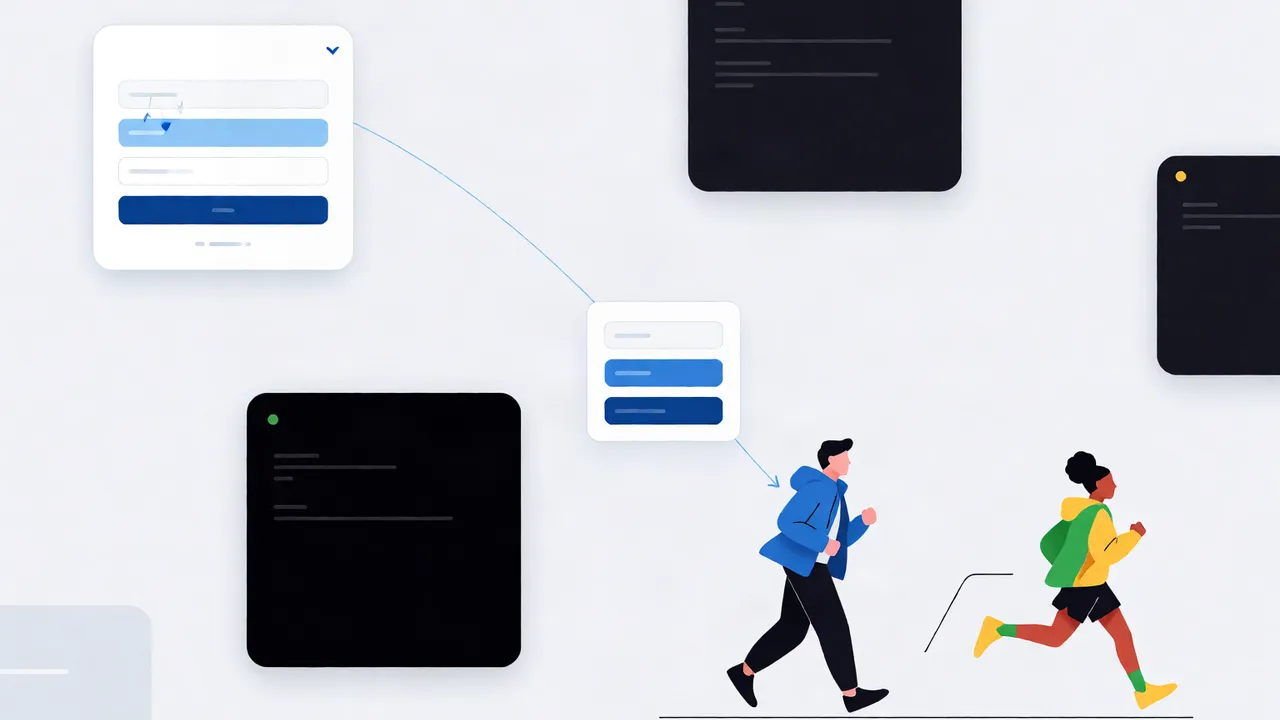
The mechanism has four phases, and only one of them involves a model. Everything after compile is mechanical execution against a recorded plan, which is why replay can be priced and reasoned about like any other browser automation.
| Phase | What happens | LLM calls | Artifact produced |
|---|---|---|---|
| Explore | Agent plans and executes against the live page | Yes, many | A successful run trace |
| Compile | Trace is minimized into a skill: stable locators, explicit waits, declared parameters, guardrails | Yes, once | A versioned skill manifest |
| Replay | Skill executes the recorded steps with bound parameters | Zero | Run result + assertion outcomes |
| Repair | Failed step is re-planned, then re-compiled into the skill | Yes, scoped to the broken step | Updated skill version |
The compile step is where the real engineering lives. A raw trace is full of noise — hover events that did nothing, a click that missed and was retried, a selector that happened to be unique on that page load. Minimizing that trace into something that survives the next run is what Twin Browser's replay capability is built around, and it is also what crafting efficient browser interactions for deterministic replay covers in more depth.
How Much Do You Actually Save with Zero LLM Calls on Replay?

Replay removes the inference line item entirely, so the savings are not a percentage — they are the whole per-run model cost, replaced by browser execution plus a small orchestration overhead. The honest framing is a break-even calculation, not a headline discount.
Think of it as:
compile_cost = tokens_spent_exploring_and_compiling × your_input_price
 + tokens_spent_planning × your_output_price
replay_cost ≈ 0 inference + browser execution
break_even_runs = compile_cost / per_run_llm_cost
If your per-run LLM cost is meaningful, break-even arrives quickly. If a task runs once a quarter, it may never arrive — and you should say so out loud rather than pretend otherwise. Where replay wins hardest:
- High-frequency, low-variance tasks. Pulling the same report, checking the same dashboard, filing the same form.
- Multi-step plans. A plan with dozens of steps means dozens of model round-trips per run; replay has none.
- Latency-sensitive paths. Replay trades model latency for page latency, which is usually a large net win.
Where it does not win: exploratory work, one-off tasks, and anything where the correct next action depends on judgment about page content. For those, the model is the product. There is a longer treatment of the token arithmetic in optimizing LLM costs in AI browser agents.
How Do You Handle Website Changes with Deterministic Replay?
You handle them by assuming they will happen and instrumenting for detection, not by hoping. Every replay step should carry a post-condition assertion, so a broken assumption fails loudly at the step that broke rather than silently producing wrong output three steps later.
A practical failure taxonomy:
| Failure | Symptom | Fix |
|---|---|---|
| Selector drift | Element not found | Prefer role/name/text locators over CSS paths; re-compile the step |
| Layout change | Wrong element clicked | Assert on post-condition, not on click success |
| Session expiry | Redirect to login | Detect redirect, pause for human authorization, resume |
| Data shape change | Parsed fields empty or shifted | Validate output schema, not just step success |
| Rate limiting | Interstitial or 429 | Backoff policy, not retry-forever |
The repair loop is the important part: when one step fails, re-plan that step and re-compile it into the skill. You are not re-exploring the whole task. That keeps repair cheap and keeps the skill's other steps stable. Advanced error handling for resilient AI browser agents goes deeper on distinguishing retryable from structural failures.
How Do You Parameterize AI Agent Skills for Late Binding?
You declare parameters at compile time and bind their values at replay time. The skill should describe what varies — account, date range, search term — without containing any of those values, which is what makes a skill reusable across accounts and tenants.
| Binding time | Good for | Risk |
|---|---|---|
| Compile time | Structural constants: the URL path, the workflow order | Skill becomes single-use |
| Replay time | Account IDs, date ranges, search terms | Needs validation at the boundary |
| Runtime secret fetch | Credentials, session tokens | Must never be logged or persisted in the skill |
Two rules I would not bend on. First, credentials come from a secret store at replay time and never appear in the skill manifest. Second, when a replay needs a logged-in account, the human authorization step comes first — consent captured up front, scoped to the account, revocable. Implementing human-in-the-loop for AI browser agents covers the authorization patterns; do not treat login as an implementation detail you bolt on later.
Deterministic Replay vs AI-Driven Automation: When Should You Use Each?
Use AI-driven automation when the task is novel, ambiguous, or judgment-dependent. Use deterministic replay when the task is known, repetitive, and verifiable. Most production systems need both, with the model handling discovery and the replay handling volume.
| Dimension | Deterministic replay | AI-driven automation |
|---|---|---|
| Per-run inference cost | Zero | Scales with steps and page size |
| Latency profile | Page-bound | Model-bound |
| Handles novel pages | No | Yes |
| Failure mode | Loud, at a specific step | Variable, sometimes plausible-but-wrong |
| Best fit | Repeat tasks at volume | Discovery, repair, exceptions |
A useful rule: run the agent three times. If all three runs look structurally identical, compile it. If they diverge, you have not finished defining the task yet.
One trade-off worth naming: a real logged-in browser beats headless when the workflow depends on an authenticated session, existing cookies, or client-side rendering that only resolves in a full browser context. Headless wins on throughput and cost when the task is genuinely stateless. Replay does not change that calculus — it just removes the model from it.
Implementing Deterministic Replay: Code Examples and Best Practices
The shape of the API matters less than the three artifacts you manage: the skill manifest, the parameter schema, and the guardrail set. Here is the shape I would expect, written as illustrative pseudocode rather than a literal SDK signature.
// Compile once: the model explores, the runtime records and minimizes.
const skill = await browser.compile({
 goal: "download last month's invoices",
 params: {
 accountId: "string",
 month: "YYYY-MM",
 },
 guardrails: [
 { after: "login", assert: "url.includes('/dashboard')" },
 { after: "download", assert: "file.size > 0" },
 ],
});

// Replay: no model in the loop.
await skill.replay({
 accountId: "acct_9182",
 month: "2026-10",
});
Best practices I would hold to:
- Assert post-conditions on every mutating step. A click that "succeeded" on the wrong element is worse than a failure.
- Version skills. A re-compile is a new version, so you can roll back when a repair makes things worse.
- Keep the plan short. Fewer steps means fewer drift surfaces. See optimizing AI agent skills for the minimization pass.
- Log the step index on failure. Debugging a replay is trivial when you know where it stopped; the debugging playbook for browser agents is worth reading before you build your own tooling.
- Do not compile a task you have not run successfully at least twice. You will compile the wrong thing.
If you are building this into a larger system, the governance layer — who can run which skill against which account — belongs in your control plane, not in the skill itself.
If you want to see how compile-and-replay is exposed in practice, Twin Browser is where we build it, and the replay capability is the part worth starting with.
FAQ
What is deterministic replay in AI browser agents?
It is the technique of recording a successful agent run as a structured plan and re-executing that plan without an LLM. The model is used once to discover and compile the workflow; every subsequent run is mechanical execution against the recorded steps.
Does deterministic replay really use zero LLM calls?
On replay, yes — the recorded plan executes without model inference. LLM calls remain in two places: the initial compile, and targeted repair when a step breaks and needs re-planning.
How do I reduce LLM costs in browser agents?
Compile repeat tasks into replayable skills so the per-run inference cost goes to zero, keep plans short to reduce drift surfaces, and reserve live model calls for discovery and repair rather than routine execution.
What happens when a website changes and my skill breaks?
The guardrail on the affected step fails, you re-plan that single step, and you re-compile it as a new skill version. You are repairing one step, not re-exploring the whole task, which keeps the fix cheap.
Can I reuse one skill across multiple accounts?
Yes, if the skill is parameterized. Declare account IDs, date ranges, and search terms as parameters, bind them at replay time, and fetch credentials from a secret store — never store them in the skill manifest.
Topics
deterministic replay AI browser agents · how deterministic replay works · benefits of deterministic replay in AI agents · deterministic vs AI-driven automation · reducing LLM costs with replay · building reliable AI agent skills · handling website changes with deterministic replay · parameterizing AI agent skills