
An AI agent control plane is the governance layer between your agent code and the browser runtime. It compiles skills once, replays deterministically with zero LLM calls, and enforces identity and policy before any action reaches the web. Build one for production agents acting on real users; skip it for local experiments.
Key takeaways
- A control plane governs runtime behavior; it is not the same as an orchestration framework.
- Agent identity is separate from user identity and requires scoped, short-lived credentials.
- Policy enforcement happens before the action executes, using allow lists, deny lists, and approval gates.
- Deterministic replay lets you audit a session without re-invoking the LLM.
- You only need centralized management once you run multiple agents across multiple users.
What is an AI agent control plane, and when do you need one?
An AI agent control plane is a control layer that sits between your agent code and the runtime. It assigns identities, evaluates policies before actions run, and records what happened. You need it when agents operate in production on behalf of real users. You do not need it for local prototypes or single-user scripts.
I learned this the hard way by adding governance after the fact. The first time I deployed a browser agent that could fill out forms, I had no idea which credential it used or whether it had already submitted a form twice. A control plane forces you to answer those questions before the agent acts, not after an incident.
As of October 2026, teams running browser agents in production are hitting the same wall: the agent works in a demo, but no one can explain what it did in a logged-in session. Speakeasy's site groups these concerns into Agent Identity, Agent Security, MCP gateway, and Agent observability, which is a useful map of what a control plane actually owns Speakeasy's control-plane product areas.
What are the core components of an AI agent control plane?

The core components are identity, a policy engine, an observability pipeline, and a state store. Identity answers who the agent is. The policy engine answers what it may do. Observability answers what it did. The state store answers where it left off.
| Component | Responsibility | Example mechanism |
|---|---|---|
| Identity | Assigns a scoped agent identity | OIDC service account, MCP agent token |
| Policy engine | Evaluates rules before and after actions | Allow lists, deny lists, approval gates |
| Observability | Records traces, logs, and spans | LLM calls, browser actions, tool outputs |
| State store | Persists session and skill state | Checkpoints, durable execution |
Trussed describes its offering as "The control plane for production AI," which captures the idea that this layer is meant for production, not prototypes Trussed AI's control-plane overview.
I would pick a minimal implementation of all four over a perfect implementation of one. A policy engine without observability is blind; observability without identity is just a log file with no owner.
How does runtime governance work for AI agents?
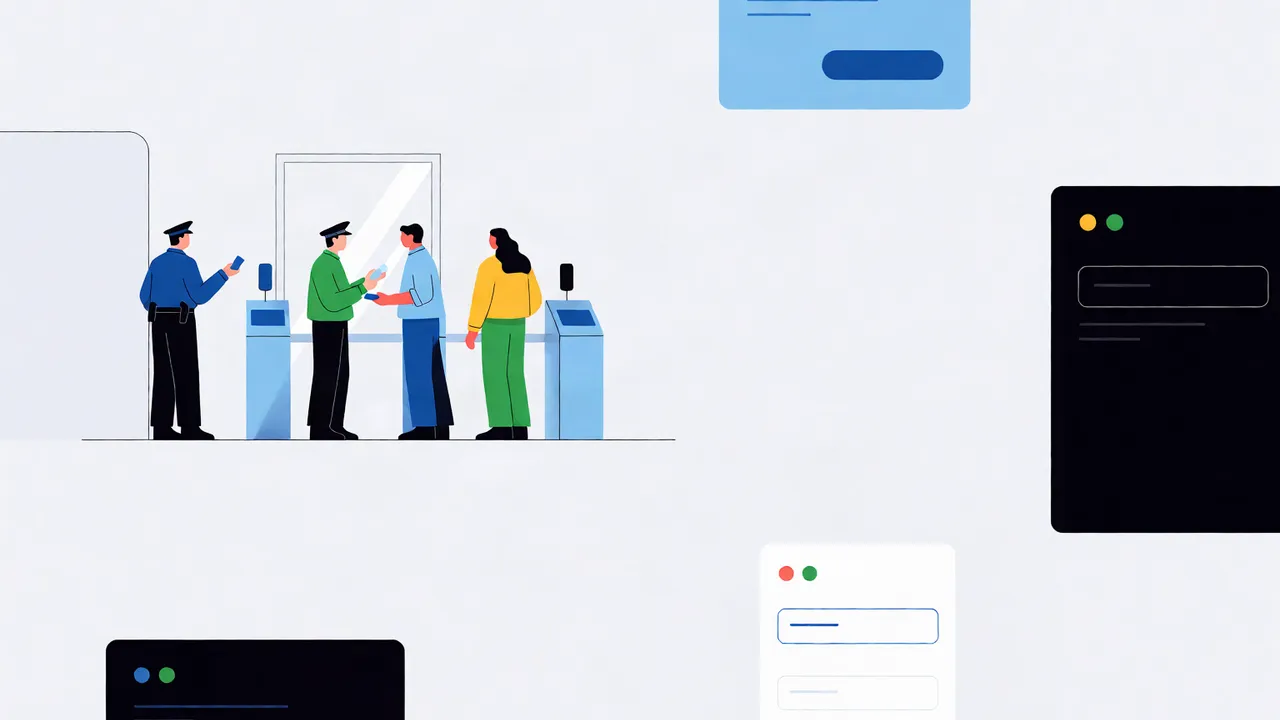
Runtime governance means the control plane intercepts actions before they reach the browser or API. When an agent calls a tool, the control plane checks the agent's identity against the requested action, then allows, denies, or escalates to a human.
Because skills compile once and replay deterministically, the recorded run is exactly what happened. There are no hidden LLM calls on replay, so your audit trail matches reality. This is different from logging LLM outputs, which can drift between runs.
In practice, I run the control plane as a sidecar or gateway alongside the agent runtime. The agent sends an intent, the control plane returns an allow or deny, and the runtime executes only if allowed.
How do you implement AI agent identity management?
Agent identity must be separate from user identity. An agent acting on behalf of a user should not inherit that user's full session cookie or password. Instead, issue a short-lived, scoped agent token tied to a specific skill or task.
Human-in-the-loop control belongs here. When an agent needs to log into a user account, the user should authorize that login explicitly. The agent does not get to replay credentials silently. I covered the mechanics of user authorization for browser agents in Implementing Human-in-the-Loop for AI Browser Agents.
If you skip this, an agent compromise becomes a user compromise. That is not a trade-off I am willing to make.
How do you enforce runtime policies and guardrails?
Guardrails are rules evaluated at the interception point. Examples I have used include no writes to admin endpoints, limits on DOM mutations, and required human approval for high-value actions. Violations block the action and create an audit event. The agent receives a structured denial, not a silent failure, so it can adjust its plan.
Here is the shape of a policy check I use:
const decision = await controlPlane.evaluate({
 agentId: "agent-123",
 action: "browser.navigate",
 target: "",
 actor: "user-456",
});

if (!decision.allowed) {
 throw new GuardrailError(decision.reason);
}
Policy enforcement is not a one-time setup. I review the deny list weekly because agents find edge cases I did not anticipate.
How do you achieve observability for AI agent workflows?
Observability means tracing every LLM call, tool invocation, and browser action. The control plane should emit a trace ID for each run so you can follow a single user request through multiple agent steps.
Deterministic replay changes the economics here. You can replay a recorded session to debug a failure without paying for another LLM inference. I wrote about the debugging workflow in Debugging AI Agents in Browser Environments.
If your observability only captures the final answer, you are flying blind. You need the intermediate steps.
How do you manage AI agent state across runs?
State management is the part most teams forget until an agent fails mid-task and cannot resume. The control plane should persist session state, skill state, and conversation checkpoints in a durable store. On replay, restore the exact state so the agent continues without re-executing prior steps.
This matters most for long-running browser workflows, such as multi-day procurement or multi-step form completion. If the browser restarts, the agent should pick up at the last checkpoint, not at the login page.
How do you build a secure control plane?
Security controls for a control plane come down to isolation, least privilege, and audit trails. Run each agent in its own browser context. Grant agents the minimum tokens they need. Keep an immutable, append-only audit log of every identity check, policy decision, and action result.
I keep a checklist for this in Securing AI Agents in Browser Automation. The hardest rule to follow in practice is isolation—it is tempting to reuse one browser profile for all agents, but that creates a single point of compromise.
Control plane vs. orchestration frameworks: what is the distinction?
Orchestration defines the workflow: which agent runs next, how they hand off, and what the graph looks like. The control plane governs the workflow: who is allowed, what is permitted, and what was recorded. You can wrap any orchestrator with a control plane.
| Orchestration framework | Control plane |
|---|---|
| Defines agent graphs and handoffs | Enforces identity and policy |
| Manages step sequencing | Records traces and audit events |
| Runs in development and production | Runs in production at scale |
For multi-agent workflows specifically, see Mastering AI Agent Orchestration: Architecting Multi-Agent Workflows in 2026.
My rule: pick the orchestrator for how agents collaborate, and add the control plane for how they are governed.
Do you need centralized AI agent management yet?
Centralized management becomes necessary when you can no longer answer three questions quickly: Who is running this agent? What is it allowed to do? What did it do last Tuesday? If you run one agent for yourself, memory is not a governance strategy.
I would not introduce a control plane for a weekend project. I would introduce it the day an agent acts on a customer's behalf and someone asks for an audit trail.
If you are building browser-based agents and need deterministic replay with zero LLM calls on replay, take a look at Twin Browser.
FAQ
What is AI agent runtime governance?
Runtime governance is the control plane enforcing policies on agent actions as they happen, rather than reviewing logs after the fact. It intercepts tool calls, checks identity and permissions, and allows, denies, or escalates before the action reaches the browser or API.
How does AI agent identity management work?
The control plane issues a distinct, short-lived identity for each agent, separate from the end user. Agents use scoped tokens for specific skills, and sensitive actions such as logging into a user account require explicit human authorization.
What is AI agent policy enforcement?
Policy enforcement evaluates rules at the interception point: allow lists, deny lists, rate limits, and approval gates. Violations block the action and generate an audit event, so the agent cannot silently bypass a guardrail.
Why is AI agent observability important?
Observability records every LLM call, tool invocation, and browser action with a trace ID. Because skills replay deterministically, you can debug a failed run without re-invoking the LLM, which keeps investigation fast and cost-predictable.
How do you manage AI agent state?
State is persisted in a durable store as session, skill, and conversation checkpoints. On replay, the control plane restores the exact state so the agent resumes from the last checkpoint instead of starting over.
Topics
AI agent control plane architecture · AI agent runtime governance · managing AI agents at scale · AI agent identity management · AI agent policy enforcement · AI agent observability · AI agent state management · AI agent security controls